Bunting Means More Than Flags: The Complete Guide to Its Decoration, Bird, Fabric and Baseball Meanings
One familiar word connects party decorations, historic flags, small songbirds and one of baseball’s most deliberate techniques—but those meanings do not all come from the same place.

Search for bunting and the results quickly become confusing. One page is about strings of colorful flags. Another defines a small bird. A baseball result discusses “bunting.” Retail pages show birthday and patriotic decorations. The problem is not that the search results are wrong; it is that bunting is a genuinely polysemous word with several established meanings.
That matters because a reader looking for “bunting meaning” may actually be asking one of several different questions: What is bunting used for? Is bunting a bird? What fabric is bunting made from? What does bunting mean in baseball? Or why are those colorful triangular flags called bunting in the first place?
The answer in one line: bunting is a word with several established meanings
Bunting is most commonly either decorative flags or fabric used for flags, but the word also refers to several small seed-eating songbirds, the act of bunting in baseball, and, in a separate American usage, a hooded infant sleeping garment. Major dictionaries including Cambridge, Oxford and Collins document these different senses.
What the current search results reveal about “bunting”
The strongest pages currently competing for the broad keyword split into a few recognizable groups.
Dictionary pages from Cambridge, Oxford and Collins concentrate on definitions and pronunciation. Wikipedia focuses on decorative bunting and its historical textile use. Retail sites compete for commercial intent by selling strings of flags, while bird resources address the ornithological meaning. The result is a mixed-intent search environment rather than a single-topic query.
That creates a clear information gap.
A dictionary gives the definition, but not always the historical story. A decoration retailer explains what to buy, but not the word’s other meanings. A bird guide explains a bunting species, but not why the same spelling appears on party banners. Baseball resources define the bunt, but rarely address the broader language question.
A stronger article has to connect those separate entities without pretending they are all one thing.
The four major search intents behind the word
| Search intent | What “bunting” means | Strongest evidence |
|---|---|---|
| Decorations | Rows or collections of flags, pennants, streamers or draped fabric | Cambridge, Oxford, Collins |
| Textile | Lightweight fabric traditionally used for flags and signals | Collins, Smithsonian |
| Bird | Several groups of small songbirds with stout or conical bills | Cambridge, Cornell, RSPB |
| Baseball | Deliberately tapping a pitched ball into the infield rather than making a normal swing | MLB |
Cambridge explicitly documents the decoration, bird and baseball senses, while Collins adds the cloth, collective-flag and infant-garment usages.
The decoration hanging over streets and celebrations
When most people in Britain encounter the word bunting, they are talking about decoration.
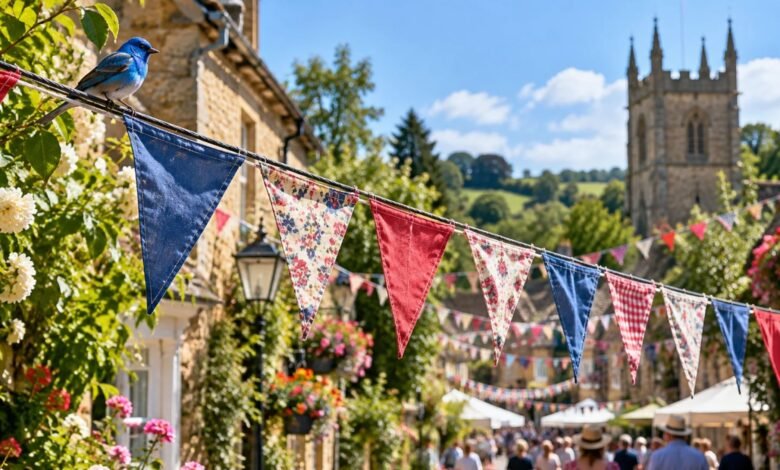
Oxford defines bunting as colored flags or paper used to decorate streets and buildings during celebrations. Cambridge similarly describes rows of brightly colored small flags, often in national colors, hung across roads, rooms or stages for special occasions and political events.
The familiar form is the triangular flag garland: individual pieces attached to a string or tape and suspended above a street, garden, party area, hall, shopfront or stage.
But triangle flags are only one form.
Decorative bunting can also appear as:
- triangular pennants;
- long strips of fabric;
- gathered swags;
- pleated fan-like arrangements;
- broad streamers;
- patriotic flag displays;
- paper versions for birthdays and school events;
- synthetic versions designed for outdoor use.
That is why “bunting” is broader than “triangle flags.” The defining idea is a decorative arrangement of flags, cloth or flag-like material, not one precise shape.
Bunting is especially associated with public celebration
The visual language of bunting is closely tied to national and civic occasions. Cambridge gives examples involving red, white and blue displays, while Collins describes bunting decorating streets and buildings on special occasions.
That helps explain why the word can immediately suggest:
- village fêtes;
- royal and national celebrations;
- weddings;
- birthdays;
- festivals;
- political events;
- sporting venues;
- street parties;
- community gatherings.
The colors can be purely decorative or deliberately symbolic. National colors are particularly common in patriotic displays, but bunting does not have to carry any political or national meaning.
The surprising part: bunting originally had a textile identity
The decoration did not appear from nowhere.
The word bunting also refers to the material from which flags were traditionally made. Collins defines the British noun as a coarse, loosely woven cotton fabric used for flags, while its American definitions include thin or coarse fabric used in flags and streamers.
Historical flagmaking gives the textile meaning a much more tangible identity.
The Smithsonian’s National Museum of American History records that the 1865 “American Bunting” national flag was the first flag made from American fabric. It was produced in Lowell, Massachusetts, by the United States Bunting Company, and the wool bunting was valued because it was light while remaining strong enough for outdoor use.
The Smithsonian also notes that the company’s bunting was supplied to the Army and Navy from 1867 until well after the First World War.
The fabric helped define the object
This is the part many modern definitions leave out.
The word did not simply become associated with colorful decorations because someone invented a catchy name for party flags. Bunting already had a textile and flagmaking history. The decorative meaning developed around material and flag use that was already established.
Oxford places the decoration sense in the early 18th century, while Collins identifies the British textile meaning and the associated flag sense. The exact deeper origin of the word remains uncertain.
The Star-Spangled Banner carries the word into American history
Few historical examples make the textile meaning clearer than the Star-Spangled Banner.
The National Park Service records that Mary Pickersgill and her assistants made the giant American flag for Fort McHenry using strips of loosely woven English wool bunting. The finished garrison flag measured 30 by 42 feet and was completed on August 19, 1813.
The Smithsonian likewise identifies English wool bunting as part of the flag’s construction.
That matters linguistically because it demonstrates that bunting was a practical flag textile long before the modern party-decoration version became familiar.
The history can be summarized cleanly:
| Date or period | What changes |
|---|---|
| Early documented bird usage | “Bunting” refers to a group of small songbirds; the deeper origin is uncertain |
| Early 18th century | The cloth/decorative meaning becomes established in English dictionaries and historical usage |
| 1813 | English wool bunting is used in the making of the Star-Spangled Banner |
| 1865 | The United States Bunting Company produces an American-made wool bunting flag |
| Modern era | Bunting becomes a familiar term for decorative flag garlands and event displays |
Oxford dates the decoration sense to the early 18th century, while the Smithsonian and National Park Service provide concrete 19th-century flag evidence.
Then there is the bird—and it is a completely different meaning
A bunting bird is not a piece of fabric.
Cambridge defines bunting as a common name for several small singing birds, including species in Europe, Asia and Africa, as well as North and South American birds with short, often stout or pointed bills.
The taxonomy becomes more interesting when individual species are examined.
Cornell’s All About Birds classifies the Indigo Bunting, Passerina cyanea, within the family Cardinalidae. The species is a small, stocky songbird; breeding males are predominantly blue, while females and immature birds are largely brown.
Cornell classifies the Painted Bunting, Passerina ciris, also in Cardinalidae. Its breeding males show vivid combinations of blue, green, yellow and red, while females and immature birds are bright green.
The Snow Bunting, Plectrophenax nivalis, is different again: Cornell places it in Calcariidae, the family containing snow buntings and longspurs.
In the United Kingdom, the Reed Bunting, Emberiza schoeniclus, belongs to the group commonly known simply as buntings and is described by the RSPB as a sparrow-sized bird with a deeply notched tail.
That means “bunting” is not a single species.
Why the bird sense can be confusing
The common-name label spans birds that are not all in one modern taxonomic family.
For example:
- Indigo Bunting — Passerina cyanea, Cardinalidae;
- Painted Bunting — Passerina ciris, Cardinalidae;
- Snow Bunting — Plectrophenax nivalis, Calcariidae;
- Reed Bunting — Emberiza schoeniclus, traditionally grouped with Old World buntings.
So a search for “bunting bird” should normally be followed by the species name.
The blue Indigo Bunting is one of the clearest examples
The Indigo Bunting shows why the bird meaning has survived so strongly in American English.
Cornell describes it as common and widespread across eastern North America. Breeding males become brilliant blue, while migration and winter can make the species harder to identify because males acquire much browner plumage.
Its behavior also sets it apart from the decorative meaning of the word. Indigo Buntings forage on seeds, berries and insects and breed in brushy and weedy habitats. Cornell reports that they migrate at night and use the stars for orientation.
That is a useful reminder that “bunting” without context does not necessarily mean party decorations.
Bunting in baseball means something entirely different again
In baseball, bunting is the act of intentionally tapping a pitched ball into the infield instead of making a conventional swing.
The official baseball rules define a bunt as a batted ball that is not swung at but is intentionally met with the bat and tapped slowly within the infield.
The technique can be used for several tactical reasons.
A batter may bunt to:
- advance a runner;
- attempt to reach first base;
- pressure the defense;
- create a sacrifice;
- execute a squeeze play in the right situation.
MLB defines a sacrifice bunt as a successful bunt that advances a runner or runners at least one base, with the batter giving up the possibility of an ordinary hit to help the team’s position.
So when a baseball article says a player was “bunting,” it is not discussing flags, cloth or birds. It is using the present participle of bunt.
The least-known definition: a baby’s hooded sleeping garment
There is also an American English meaning that can surprise British readers.
Collins lists bunting as a U.S. term for a baby’s garment made from soft, warm material and shaped like a hooded blanket that exposes the face. Dictionary.com likewise lists a hooded sleeping garment for infants as a separate American noun.
This usage is not connected to birds or decorative flags in the ordinary modern sense.
It is best understood as another dictionary-defined meaning that happens to share the same spelling.
Is “bunting” singular or plural?
This is one of the easiest points to misunderstand.
When bunting means decorative material, it is usually treated as an uncountable noun:
“The street was covered in bunting.”
Cambridge labels the decoration meaning as uncountable, while Collins similarly describes it as an uncountable noun in its principal decoration definition.
When bunting means a bird, it can be countable. Cambridge gives “bunting” and “buntings” as possible plural forms.
That produces a practical distinction:
| Example | Meaning |
|---|---|
| “The hall was decorated with bunting.” | Decorative flags or fabric |
| “We saw a bunting in the reeds.” | One bird |
| “Several buntings were feeding nearby.” | Multiple birds |
| “The coach called for bunting.” | Baseball technique |
Where did the word itself come from?
The honest answer is that the deeper etymology is not completely settled.
Collins gives an uncertain origin for the cloth sense and notes a possible connection to Middle English bonten, associated with sifting. Its American entry dates the fabric-related word to the 18th century.
Oxford treats the two principal learner-dictionary meanings separately and says the bird sense has a Middle English origin of unknown origin, while the decoration sense belongs to the early 18th century and is likewise described as of unknown origin.
That distinction is important.
It is tempting to assume the bird, fabric and decoration senses all descended from one neat original definition. The dictionary evidence does not justify that simplification.
The word has a layered history rather than a single clean origin story
The safest interpretation is:
- The bird name has its own older history and uncertain etymology.
- The textile sense became associated with lightweight flag material.
- The decorative sense developed from the use of flags and flag-like fabric as display material.
- Baseball “bunting” comes from the separate verb “bunt.”
- The infant-garment sense represents another specialized American usage.
The spelling is shared, but the meanings should not automatically be treated as one historical family.
Why modern bunting looks so different from historic flag cloth
Traditional bunting was valued for flagmaking because the fabric had to balance weight, durability and wind resistance. The historical material was commonly wool, while later and modern bunting can also use cotton or synthetic fibers.
Today’s party bunting can be made from:
- cotton;
- polyester;
- paper;
- card;
- felt;
- other lightweight synthetic materials.
The purpose has changed from signaling and formal flag display to decoration, but the visual logic remains surprisingly similar: light materials arranged so they can hang, move and remain visible from a distance.
Bunting and flags are related—but not identical
A flag is generally one discrete emblematic piece of material.
Bunting can refer to:
- the material used to make flags;
- a collection of flags;
- decorative strings of flags;
- wider draped displays.
Collins explicitly includes “flags collectively,” particularly those associated with a boat, among the British meanings.
That is why historical naval references can use the word in ways that sound different from modern birthday-party usage while still referring to the same broader flag vocabulary.
The clearest way to identify which meaning someone intends
Context usually solves the ambiguity.
| Context | Likely meaning |
|---|---|
| Birthday, wedding, party | Decorative bunting |
| Street celebration or national holiday | Decorative or patriotic bunting |
| Sewing or flagmaking | Bunting fabric |
| Birdwatching | A bunting species |
| Colorado bird references | Lark Bunting |
| Eastern North American bird references | Indigo Bunting |
| Arctic bird references | Snow Bunting |
| Baseball | The act of laying down a bunt |
| Baby products in U.S. English | Infant bunting garment |
| Naval or maritime history | Flag material or flags collectively |
This context-first approach is more accurate than assigning one definition to every appearance of the word.
A compact fact grid for “bunting”
| Detail | Verified meaning or fact |
|---|---|
| Pronunciation | UK /ˈbʌntɪŋ/; U.S. /ˈbʌntɪŋ/ |
| Primary decorative meaning | Rows of small colored flags, fabric or paper used for celebration |
| Textile meaning | Lightweight or loosely woven material historically used for flags |
| Bird meaning | Several small songbirds commonly called buntings |
| Baseball meaning | Intentional tapping of a pitched ball rather than a conventional swing |
| Infant meaning | U.S. hooded sleeping garment for babies |
| Historical flag example | Star-Spangled Banner made partly from English wool bunting |
| Major modern bird examples | Indigo, Painted, Snow, Reed and Lark Buntings |
The core definitions are documented by Cambridge, Oxford and Collins, while the historical and species-specific facts are supported by the Smithsonian, National Park Service, Cornell Lab and RSPB.
What the top-ranking pages still leave unanswered
The current search ecosystem is strong on individual definitions but weaker at explaining the relationship between the meanings.
Cambridge is particularly useful because it puts decoration, bird and baseball senses together. Oxford adds clarity around the two major noun meanings and their word histories. Collins goes further by documenting cloth, collective flags and the infant garment.
The bigger opportunity is synthesis.
A reader should not have to open five separate pages to understand why “bunting” can mean a string of flags in one sentence and a bird in another. The word is best explained as a dictionary-level entity with several established senses, not as one object with a dozen random uses.
That distinction is particularly important for search engines and AI answer systems because the query itself does not always reveal the intended sense.
Frequently Asked Questions About Bunting
What is bunting?
Bunting is a word with several established meanings. Most commonly, it means rows or collections of decorative flags, fabric or paper used for celebrations. It can also mean the lightweight material historically used for flags, several kinds of small songbirds, the baseball technique of tapping the ball into the infield, and a U.S. infant sleeping garment.
Is bunting the same as a flag?
Bunting is related to flags but is not exactly the same thing. Bunting can mean the fabric used to make flags, a collection of flags, or a decorative arrangement of small flags and streamers. A single national flag is therefore not necessarily called bunting, while a string of small decorative flags can be.
Why is it called bunting?
Bunting is called bunting because the word developed alongside meanings connected with specialized cloth and flags, while the decorative sense later became associated with displays made from that material. The exact deeper etymology is uncertain. Oxford and Collins both indicate that the origins of the major noun senses are not completely settled.
Is a bunting a bird?
Yes. Bunting is a common name applied to several small singing birds. Examples include the Indigo Bunting, Painted Bunting, Snow Bunting, Reed Bunting and Lark Bunting. These birds are not all placed in one modern family; Cornell lists Indigo and Painted in Cardinalidae and Snow Bunting in Calcariidae, while the RSPB lists Reed Bunting as Emberiza schoeniclus.
What does bunting mean in baseball?
Bunting in baseball means intentionally tapping the pitched ball rather than taking a conventional full swing. Official baseball rules define a bunt as a ball intentionally met with the bat and tapped slowly into the infield. A sacrifice bunt is a specialized situation in which the batter gives up the chance for an ordinary hit to advance a runner.
What is baby bunting?
In American English, bunting can refer to a soft hooded sleeping garment for an infant. Collins and Dictionary.com both record this as a separate noun meaning from the decorative and bird senses. The term is therefore context-dependent, especially in U.S. product and parenting language.
The word survives because each meaning has its own world
Bunting is not a strange case of one word being stretched beyond recognition. Its separate meanings are firmly established across dictionaries, history, ornithology and sport.
The decorative bunting hanging above a street has roots in the language of cloth and flags. The historic textile bunting appears in major American artifacts such as the Star-Spangled Banner. The bird sense belongs to a long tradition of common bird names covering several species and families. The baseball sense comes from the verb bunt. And the infant-garment sense is a recognized American usage of its own.
That is the key fact searchers often miss.
Sources & Verification
- Cambridge Dictionary — Bunting — decoration, bird and baseball definitions, pronunciation and usage.
- Oxford Advanced Learner’s Dictionary — Bunting — decorative and bird meanings plus word-origin notes.
- Collins English Dictionary — Bunting — cloth, flags, decoration, bird and U.S. infant-garment meanings.
- Smithsonian National Museum of American History — “American Bunting” National Flag — historical wool bunting and the 1865 American Bunting flag.
- National Park Service — The Great Garrison Flag — wool bunting used in the Star-Spangled Banner.
- Cornell Lab of Ornithology — Indigo Bunting — species identification, behavior, habitat and taxonomy.
- Cornell Lab of Ornithology — Painted Bunting — species description and taxonomy.
- Cornell Lab of Ornithology — Snow Bunting — species profile and family classification.
- RSPB — Reed Bunting — UK species profile.
- MLB — Sacrifice Bunt — official baseball terminology.
Editorial Disclaimer: This article distinguishes established dictionary meanings, historical records and species-specific evidence from uncertain etymological claims. Definitions and classifications can evolve across dictionaries, taxonomic systems and regional English usage. Information has been checked against the cited sources available as of September 13, 2026
Read More on Deeply News