Roy Broadbent and Doreen Broadbent: The Wartime Artists Who Helped Shape Jim Broadbent’s Life Before the Oscar
Long before Jim Broadbent became an Oscar-winning actor, his parents were building an unusual artistic community in rural Lincolnshire—one shaped by pacifism, furniture making, sculpture, amateur theatre and an almost stubborn belief that art belonged to everyone.

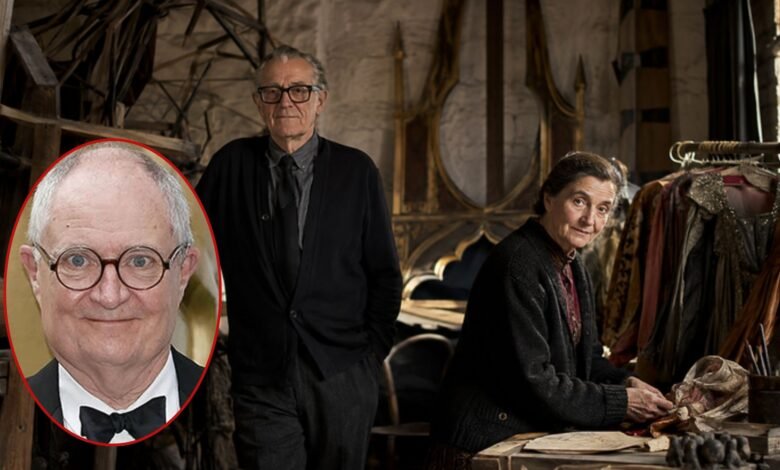
The name Jim Broadbent now belongs to the history of British film: Iris, Moulin Rouge!, Bridget Jones’s Diary, Harry Potter, The Iron Lady, Paddington and more. But the roots of that career sit far away from Hollywood premieres and awards ceremonies.
They lead back to Holton cum Beckering in Lincolnshire, where Broadbent was born in 1949 and where his parents, Roy Laverick Broadbent and Doreen “Dee” Findlay Broadbent, helped create a community built around farming, pacifism and amateur theatre. Roy was an artist, furniture maker, interior designer and sculptor; Doreen was a sculptor and amateur actress. Together they helped found the Holton Players, the theatrical group that eventually became associated with the Broadbent Theatre in Wickenby.
The story matters in 2026 because the theatre still operates under Roy Broadbent’s name. The current Broadbent Theatre describes itself as the home of Lindsey Rural Players, while Jim Broadbent remains its president. The building is therefore not simply a memorial to a famous actor’s father: it is a surviving piece of the community his parents helped construct.
BLUF: Roy Broadbent and Doreen “Dee” Broadbent were the artistic and theatrical parents of actor Jim Broadbent. Roy worked across furniture, design, sculpture and architecture, while Doreen was a sculptor and amateur actress. Both were involved in the wartime Holton Players, helping establish the creative environment that shaped Jim’s early life and later acting career.
Roy and Doreen Broadbent at a glance
- Roy Laverick Broadbent: Artist, furniture maker, interior designer, sculptor and amateur actor.
- Doreen “Dee” Findlay Broadbent: Sculptor and amateur actress.
- Community: Part of the conscientious-objector community in rural Lincolnshire during and after the Second World War.
- Theatre group: Roy and Dee were founders of the Holton Players.
- Location: Holton cum Beckering and later Wickenby, Lincolnshire, England.
- Son: James “Jim” Broadbent, born 24 May 1949 in Lincolnshire.
- Theatre legacy: Roy contributed resources to the conversion of a former Methodist chapel into a theatre in Wickenby; it was subsequently named the Broadbent Theatre after his death.
- Long-term influence: Their combination of art, community theatre and pacifist values formed a distinctive childhood environment for Jim Broadbent.
The family began with a very different idea of what a “normal” wartime life looked like
Roy Broadbent’s story cannot be separated from the unusual community that emerged in Lincolnshire during the Second World War.
Roy was connected to the Peace Pledge Union and became a conscientious objector. According to The Guardian, he had studied architecture and met accountant Dick Cornwallis, another conscientious objector, through the peace movement. The two helped establish a scheme through which conscientious objectors could train in agriculture rather than participate in the war effort.
They leased Collow Abbey Farm near Holton cum Beckering, where young conscientious objectors arrived—many from urban, professional or artistic backgrounds—with little experience of agricultural labour. The community included accountants, teachers, journalists, artists, clerks and bookbinders. The work was demanding, but the cooperative environment survived beyond the war and influenced the surrounding area for decades.
Roy and Doreen belonged to this world. Their lives combined practical work with creative activity, and theatre quickly became one of the community’s defining social outlets.
The official history of the Broadbent Theatre describes the Holton Players as emerging from this wartime community. Even when electricity was scarce and entertainment options were limited, residents gathered for musical evenings, singing, poetry and play readings. Local children were welcomed into the activities.
That detail is crucial to understanding Jim Broadbent. He did not first encounter acting as a distant profession performed by famous strangers. Theatre was simply part of life around him.
Roy Broadbent turned practical design into a second kind of theatre
Roy’s professional identity was broader than the shorthand “Jim Broadbent’s father” suggests.
Biographical sources identify him as a furniture maker, artist, sculptor, interior designer and amateur actor. The Guardian additionally describes him as an architecture student before he entered the Lincolnshire community.
That mixture of skills helps explain why Roy played such an important role in the physical development of the theatre community.
The Holton Players initially performed in an abandoned Nissen hut, a structure associated with the wartime agricultural and prisoner-of-war environment. After the war, the group adapted the building for theatrical use. The theatre was eventually destroyed by fire after an electrical fault; the official Broadbent Theatre history dates the fire to March 1960.
The Players continued despite the loss.
For a time, productions were staged in the drawing room of Holton Hall, with performers using the architecture of the room itself as part of the production. The group eventually found a more permanent home in Wickenby.
In 1970, the Holton Players purchased a former Methodist chapel in the village. Members of the group carried out the conversion, with much of the necessary resources supplied by Roy Broadbent and Douglas Ballard. The resulting theatre was designed for an audience of about 100 people.
Roy died shortly after the theatre opened.
The group chose to preserve his name in the building, giving the venue the name it carries today: the Broadbent Theatre.
Doreen “Dee” Broadbent was more than the mother of a future movie star
Doreen’s public biography is less extensively documented than Roy’s, but the reliable record is consistent on the central facts.
She was born Doreen Findlay, was known as Dee, and was a sculptor and amateur actress. Established biographical sources identify her as one half of an artistic household in which visual art and performance existed side by side.
That combination was unusual but important.
Roy worked with objects, spaces and design. Doreen worked with sculpture and performance. Both were connected to amateur theatre. Together, they created an environment where making things and performing things were not sharply separated.
The evidence also places Dee directly inside the Holton Players tradition rather than merely adjacent to it. The Broadbent Theatre’s own history identifies the troupe as founded by Roy and his wife Dee alongside the conscientious-objector community at Holton-cum-Beckering.
This is why describing Doreen simply as “Jim Broadbent’s mother” loses something important. Her own artistic identity predated her son’s fame, and sculpture was a serious part of the family’s creative culture.
There is less dependable public information available about her individual exhibitions, formal education or detailed career chronology. Those gaps should remain gaps rather than be filled with unsourced dates or invented credits.
The Holton Players gave Jim Broadbent a stage before he ever entered drama school
Jim Broadbent was born in 1949 in Holton cum Beckering, Lincolnshire, into precisely this artistic environment. The Independent describes him as the youngest of three children of a furniture maker who also ran an amateur-dramatics society and a sculptress.
His first experience of acting came astonishingly early.
According to The Guardian, Broadbent made his acting debut as a child in Ibsen’s A Doll’s House, staged in the old Nissen hut used by the community.
The setting is almost a perfect summary of his childhood: wartime conscientious objectors, an improvised theatre, rural Lincolnshire and parents who considered amateur performance a worthwhile community activity.
The later professional actor therefore did not enter theatre from nowhere. He had already experienced rehearsals, performances, audiences and backstage activity while still a child.
“He had huge confidence.” — Jim Broadbent, recalling his father’s encouragement.
That confidence mattered. Broadbent later recalled that Roy encouraged him to become an actor and was the person who first suggested drama school.
The father’s influence was therefore practical rather than simply genetic. Roy did not merely give Jim an artistic household; he actively supported his son’s decision to pursue acting.
A wartime philosophy followed Jim into adulthood
The Broadbent family’s influence was not limited to the arts.
Both Roy and Doreen were associated with a community whose existence was grounded in conscientious objection and pacifism. The young people who joined the Lincolnshire settlement had rejected military participation and instead chose agricultural labour and communal living.
Jim Broadbent later described his upbringing in terms that reflect those values.
In a profile for The Spectator, he was described as being born to pacifist parents, Doreen and Roy, and as having inherited aspects of that outlook. He later attended Leighton Park School, a Quaker school in Reading.
The connection between his parents’ beliefs and Jim’s later personality should not be exaggerated into a simplistic cause-and-effect claim. Acting is shaped by training, temperament, experience and opportunity. But there is strong evidence that the Broadbent household exposed him early to both artistic experimentation and a serious ethical tradition centered on nonviolence and community.
In other words, the family legacy was not only theatrical.
It was philosophical.
Roy’s death left an unfinished story for his son
One of the most revealing accounts of Roy Broadbent comes from Jim himself.
In an interview published by journalist Nigel Farndale, Broadbent said his father died of cancer when Jim was 23. Roy had been a furniture maker, had moved from Yorkshire to Lincolnshire during the war and remained deeply connected to his son’s career ambitions.
Broadbent remembered being able to travel home during his early professional work and being present when his father died. The experience later became unexpectedly relevant when he played a dying father in And When Did You Last See Your Father?
His comments also reveal how he viewed Roy as a parent.
Rather than describing a demanding artistic patriarch, Broadbent remembered someone who encouraged him, praised him and had confidence in his abilities. He also regretted that Roy never lived long enough to see what his son would eventually accomplish.
That timing is significant.
Roy died before Jim’s international breakthrough, before The Crying Game, before Life Is Sweet, before Topsy-Turvy, before Moulin Rouge! and before the Oscar for Iris.
The father who encouraged the career never saw its full scale.
Doreen lived long enough to see a very different chapter of Jim’s life
Doreen survived Roy by more than two decades.
According to Farndale’s interview, she died in 1995 after suffering from Alzheimer’s disease. Broadbent said he was present around the time of her death and later explained that his experience of watching his mother deteriorate informed his performance in Iris.
That connection became particularly poignant because Iris was the film that transformed Broadbent’s professional standing.
He played writer John Bayley opposite Judi Dench as novelist Iris Murdoch. The performance won the Academy Award for Best Supporting Actor at the 74th Academy Awards in 2002.
BAFTA’s retrospective on Broadbent similarly identifies Iris as one of the defining performances of his career and notes that he won an Oscar and Golden Globe for the role.
By then, both of his parents were gone.
The Oscar belonged to Jim Broadbent, but the cultural inheritance behind the actor was older than the award itself.
The theatre that carries Roy Broadbent’s name is still alive
The most tangible surviving memorial to Roy and Doreen is not a plaque or a biography.
It is a working theatre.
The Broadbent Theatre stands on Snarford Road in Wickenby, Lincolnshire, and remains the home of the Lindsey Rural Players. The official theatre site states that the venue is licensed for an audience of 100 and is used for amateur productions, professional shows, community organisations and youth theatre.
The theatre is operated by the Lindsey Rural Players, which is a registered charity. Its current official website continues to identify Jim Broadbent as president, maintaining a direct link between the current organisation and the founder whose name appears above the entrance.
That continuity is unusual.
Roy’s theatre was created through volunteer labour, artistic commitment and community cooperation. Decades later, it remains a functioning cultural institution rather than a static memorial.
The venue’s own history makes another point worth remembering: its roots were not originally about celebrity. The Holton Players were formed for people who wanted music, drama, poetry and companionship in a small rural community.
Jim Broadbent became famous.
The theatre did not.
That may be precisely why the story remains interesting.
The Broadbent family story in a compact evidence grid
| Person or institution | Verified role or significance | Key evidence |
|---|---|---|
| Roy Laverick Broadbent | Artist, furniture maker, interior designer, sculptor and amateur actor | Biographical sources and theatre history |
| Doreen “Dee” Findlay Broadbent | Sculptor and amateur actress | Biographical sources |
| Holton Players | Amateur dramatic group associated with the wartime Lincolnshire community | Broadbent Theatre history |
| Nissen-hut theatre | Early performance space where Jim Broadbent made his childhood acting debut | The Guardian |
| Wickenby Methodist chapel | Purchased in 1970 and converted into the later theatre | Broadbent Theatre history |
| Broadbent Theatre | 100-seat community theatre named for Roy after his death | Official theatre history |
| Jim Broadbent | Son of Roy and Doreen; actor whose career was rooted in stage and film | The Independent, BAFTA, Oscars |
The chronology that connects war, theatre and Hollywood
| Period | What the evidence shows |
|---|---|
| Second World War | Roy Broadbent and other conscientious objectors were part of a Lincolnshire farming community formed around pacifism and agricultural work. |
| Wartime / postwar years | Roy and Doreen were involved with the Holton Players, an amateur dramatic group emerging from the community. |
| 1949 | James “Jim” Broadbent was born in Holton cum Beckering, Lincolnshire. |
| Childhood | Jim appeared in A Doll’s House in the community’s Nissen-hut theatre. |
| March 1960 | The early Nissen-hut theatre was destroyed by fire caused by an electrical fault. |
| 1970 | The Holton Players purchased the former Methodist chapel at Wickenby and converted it into a theatre. |
| Early 1970s | Roy Broadbent died from cancer when Jim was about 23; the new theatre was named in his memory. |
| 1995 | Doreen Broadbent died after Alzheimer’s disease, according to Jim Broadbent’s later interview. |
| 2002 | Jim Broadbent won the Academy Award for Best Supporting Actor for Iris. |
| 2026 | The Broadbent Theatre remains an active community venue, with Lindsey Rural Players continuing to operate it and Jim Broadbent serving as president. |
The strongest clue to Jim Broadbent’s character may be his father’s encouragement
It is easy to construct celebrity biographies around famous moments: the Oscar, the blockbuster, the red carpet, the career breakthrough.
Roy and Doreen Broadbent point in the opposite direction.
Their influence was built through ordinary repeated acts—forming a theatre group, making furniture, creating sculpture, performing for neighbours, adapting buildings and supporting an artistic community in a rural part of England.
Jim eventually entered professional theatre after graduating from the London Academy of Music and Dramatic Art in 1972, but his first education in performance happened much earlier, inside his parents’ world.
BAFTA’s history of his career shows how far that early education eventually carried him: major work with Mike Leigh, Topsy-Turvy, Moulin Rouge!, Iris and an exceptionally long stage and screen career.
Yet the most revealing detail remains small.
Roy believed his son could act.
He encouraged him to pursue drama school.
That is a very different kind of legacy from an inheritance or a famous surname. It is confidence passed from one generation to another.
What can actually be verified about Roy and Doreen’s private lives?
The historical record is substantial enough to establish their artistic and theatrical identities, their connection to the Lincolnshire conscientious-objector community and their relationship to the Holton Players. It is much thinner when it comes to private biographical details such as exact birth dates, detailed schooling, personal finances or a complete catalogue of artistic works.
That distinction matters.
Newer biography sites sometimes publish precise details that cannot be independently confirmed through strong sources. Those details should not automatically be repeated simply because multiple websites carry them.
For Roy Broadbent, the evidence is strongest around his work as an artist and furniture maker, his conscientious-objection background, his involvement with theatre and the development of the Wickenby venue. For Doreen, the strongest evidence identifies her as a sculptor, amateur actress and key member of the same artistic household.
The missing details are not a weakness in the story.
They are a reason to keep the biography precise.
Financial record: there is no defensible Broadbent family wealth figure
There is no authoritative public net-worth figure for Roy Broadbent or Doreen Broadbent.
No reliable financial publication, audited statement, probate-based wealth assessment or transparent asset record located in the strongest sources establishes a figure that could responsibly be presented as their personal wealth.
The available evidence instead points toward working artistic careers, community theatre and practical design rather than a documented high-value celebrity fortune. Roy’s family background and professional work have been discussed in historical reporting, but those details are not enough to calculate a credible personal estate.
Any exact “net worth” number attached to either parent should therefore be treated as unverified.
People Also Ask: Roy and Doreen Broadbent
Who were Roy and Doreen Broadbent?
Roy Broadbent and Doreen “Dee” Broadbent were the parents of actor Jim Broadbent and active members of Lincolnshire’s amateur theatre community. Roy worked as an artist, furniture maker, interior designer and sculptor, while Doreen was a sculptor and amateur actress. They helped establish the Holton Players, whose history eventually led to the Broadbent Theatre in Wickenby.
What did Roy Broadbent do for a living?
Roy Broadbent was an artist, furniture maker, interior designer and sculptor, with an architectural background, as well as an amateur actor. He was also involved in the creation and development of community theatre in Lincolnshire. His practical design skills were especially important when the Holton Players converted a former Methodist chapel in Wickenby into the theatre later named after him.
Who was Doreen “Dee” Broadbent?
Doreen “Dee” Broadbent, born Doreen Findlay, was a sculptor and amateur actress and the mother of Jim Broadbent. She and Roy were connected to the Holton Players and the wartime artistic community in rural Lincolnshire. Although less private biographical information survives about her than about her famous son, her place in the family’s artistic culture is firmly documented.
Were Jim Broadbent’s parents actors?
Yes. Roy and Doreen Broadbent were both amateur actors. They helped establish the Holton Players, a community theatre group formed among a wider conscientious-objector community in Lincolnshire. Theatre was therefore a normal part of Jim Broadbent’s childhood, and he made his own acting debut as a child in an Ibsen production staged by the community.
How did Roy and Doreen Broadbent influence Jim Broadbent?
Roy and Doreen Broadbent gave Jim an unusually early immersion in theatre, visual art and community performance. Jim saw his parents act, experienced theatre as a child and grew up around artists and conscientious objectors. Roy later encouraged him to attend drama school, giving direct support to the professional path that eventually produced his Oscar-winning career.
What is the Broadbent Theatre?
The Broadbent Theatre is a community theatre in Wickenby, Lincolnshire, created from a former Methodist chapel purchased by the Holton Players in 1970. Roy Broadbent contributed resources to its conversion, and after his death the Players named the theatre in his memory. The venue remains the home of Lindsey Rural Players and continues to stage community and professional productions.
The Roy Broadbent name means more than Jim Broadbent’s surname
Roy and Doreen Broadbent never became household names.
Their son did.
But that imbalance can obscure the more interesting truth: Jim Broadbent’s acting career emerged from a family that was already deeply involved in creativity before the world had any reason to know the Broadbent name.
Roy brought furniture making, design, sculpture, architecture and amateur performance into the same life. Doreen brought sculpture and acting. Around them was a community of conscientious objectors who transformed rural Lincolnshire into an unexpectedly active centre for theatre and the arts.
The Broadbent Theatre remains the clearest physical reminder of that history.
Its 100-seat auditorium is modest by professional theatrical standards. Its origin story is anything but modest. A former Methodist chapel, a wartime pacifist community, a group of amateur performers, a furniture maker who helped build the space and a boy who performed there before eventually becoming an Oscar winner are all part of the same chain.
Jim Broadbent inherited the public career.
Roy and Doreen Broadbent built much of the cultural ground beneath it.
Related reading
Theodora Holmes: The Private Force Behind Troy Polamalu’s Family, Faith and Football Legacy
Sources & Verification
- The Broadbent Theatre — History: Primary institutional source for Roy and Dee Broadbent, the Holton Players, the Wickenby theatre conversion and the theatre’s continuing operation. Broadbent Theatre official history
- The Guardian — “Utopia in Lincolnshire: the pacifists who built a farm – and stayed”: Detailed reporting on the wartime conscientious-objector community, Roy Broadbent, the Holton Players and Jim Broadbent’s childhood acting debut. The Guardian report
- The Independent — “Jim Broadbent: A topsy-turvy life”: Contemporary biographical reporting on Jim Broadbent’s parents, childhood and early artistic environment. The Independent profile
- Nigel Farndale — Jim Broadbent interview: First-person recollections from Broadbent about his father Roy, his mother Dee, their influence and their deaths.
- BAFTA — Jim Broadbent: A Life in Pictures: Official career history and awards context for Broadbent. BAFTA career retrospective
- Academy of Motion Picture Arts and Sciences — 74th Academy Awards: Official confirmation of Broadbent’s Best Supporting Actor Oscar for Iris. Official Oscars record
- Visit Lincolnshire — Broadbent Theatre: Current regional tourism information confirming the venue, its history and its connection to Roy Broadbent.
Editorial Disclaimer
This article distinguishes verified historical information from claims that are difficult to independently substantiate. Exact personal dates, financial figures, private family details and complete artistic records for Roy and Doreen Broadbent are not widely documented in authoritative sources. Where evidence is incomplete, no unsupported estimate or biography-site claim has been presented as established fact.

One Comment