Stormuring Explained: What Hey’di’s 15 kg Waterproof Mortar Can—and Cannot—Do
The name looks like a generic construction term, but the product behind the search is far more specific—and its technical paperwork reveals where Stormuring genuinely earns its reputation.

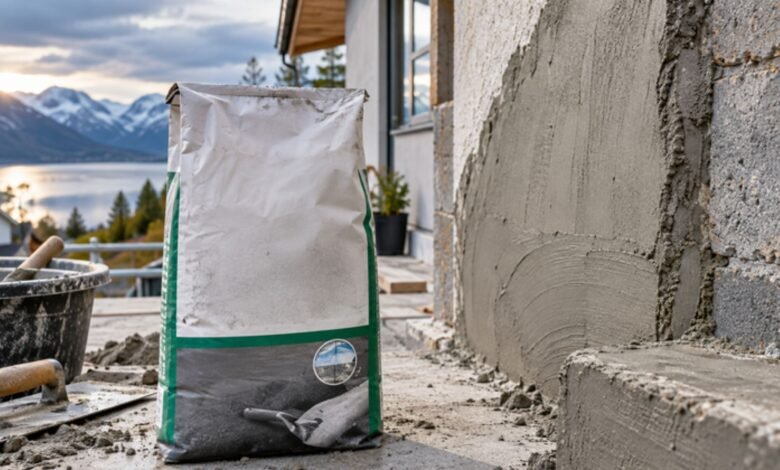
Water intrusion rarely starts as a dramatic structural failure. It usually begins with a cracked patch of render, a porous joint, a damaged masonry surface, or a repair that never bonded properly. Once water finds that weak point, the repair problem can become a maintenance problem.
That is where Stormuring enters the conversation. In the context of the product shown in search results, Stormuring refers primarily to Hey’di Stormuring, a Norwegian cement-based, fiber-reinforced dry mortar designed for masonry, rendering, and repair work. Hey’di positions it for both indoor and outdoor use on masonry, brick, lightweight aggregate blocks, concrete, and certain rock transitions.
The important distinction is that Stormuring is not simply another bag of ordinary cement mortar. Its stated combination of fiber reinforcement, rapid hardening, broad application range, and water-resistant/waterproof positioning makes it a specialist repair and rendering material—but it still has limits that matter on serious construction projects.
Stormuring is a fiber-reinforced, cement-based multimortar from Hey’di, supplied in 15 kg bags for masonry, rendering, and repair work. Manufacturer documentation specifies about 1.7 kg/m² per millimetre of render thickness, roughly 9 litres of mixed material per bag, and application in thin or thick layers up to 8–10 cm in one operation.
The Product Behind the Stormuring Search Term
Stormuring is best understood as a specific construction product rather than a broad building technique. Hey’di identifies it as a fiber-reinforced “do-it-yourself” multimortar, while its safety documentation classifies it as a cement-based dry mortar for building and construction applications. The product number is 211, with GTIN 7054150002110 and NOBB number 30160782.
The manufacturer’s description is unusually broad. Stormuring is intended for:
- Masonry work
- Rendering and plastering
- Repair work
- Brick and masonry surfaces
- Lightweight aggregate materials such as Leca
- Concrete
- Certain transitions between concrete, masonry, and rock
- Hollow coves or fillets at structural transitions
Hey’di also describes the material as flexible in application, saying it can be placed in both thin and thick layers and adheres well to the underlying surfaces.
That combination explains why Stormuring appears in searches alongside words such as mortar, waterproofing, concrete repair, wall rendering, masonry repair, and waterproof plaster.
A quick technical snapshot
| Characteristic | Hey’di Stormuring |
|---|---|
| Product type | Fiber-reinforced cement-based dry multimortar |
| Package | 15 kg bag |
| Product number | 211 |
| GTIN | 7054150002110 |
| NOBB | 30160782 |
| Typical application | Masonry, rendering, repairs |
| Suitable substrates | Masonry, brick, lightweight aggregate, concrete and rock-related transitions |
| Material consumption | Approx. 1.7 kg/m²/mm |
| Yield | Approx. 9 litres mixed material per 15 kg bag |
| Maximum single-layer application | Up to 8–10 cm |
| Working time | Approx. 1 hour |
| Largest aggregate size | 1 mm |
| Minimum application temperature | +6°C |
| Storage | Dry; best-use properties within about one year from production |
These specifications come from Hey’di’s product documentation and current product literature.
Why Stormuring Is More Than a Standard Repair Mortar
A conventional repair mix can solve a very narrow problem. Stormuring is deliberately positioned as a multi-purpose mortar, allowing the same product family to be used for rendering, masonry-related work, and repairs.
The fiber reinforcement is part of that positioning. Rather than presenting Stormuring as an ordinary cement-and-aggregate mix, Hey’di describes it specifically as fiber-reinforced and suitable for both thin and substantial layers. The 2025 Hey’di surface-treatment brochure also identifies it as a waterproof repair mortar and says it is particularly suitable as a waterproofing render on the inside and outside of masonry and concrete surfaces.
That matters when the repair has to accomplish more than simply filling a hole.
A render layer may need to provide a continuous surface. A repair may involve deeper material loss. A masonry transition may require a shaped fillet rather than a flat patch. Stormuring’s stated ability to handle substantially thicker applications is one of the reasons it occupies a different position from small-job patching mortars.
Hey’di’s 2024 product material states that a 15 kg bag produces approximately 9 litres of mixed mortar, while consumption for rendering is about 1.7 kg per square metre for every millimetre of thickness.
That yields a practical rule of thumb:
- 2 mm layer: about 3.4 kg/m²
- 5 mm layer: about 8.5 kg/m²
- 10 mm layer: about 17 kg/m²
The last figure is also reflected directly in Hey’di’s 2025 product information, which gives approximately 17 kg/m² at 10 mm thickness.
Those numbers are theoretical consumption figures. Actual coverage changes with surface unevenness, application technique, substrate absorption, waste, and how aggressively the mortar is built up.
The Mixing Detail That Can Change the Final Result
One of the most useful details in the Stormuring documentation is also one of the easiest to overlook: water quantity is not presented as an excuse for indiscriminate over-watering.
Hey’di’s technical data summary specifies approximately 3 litres of water per 15 kg bag. However, the body of the 2023 technical datasheet says to begin with approximately 2.7 litres, then adjust the consistency according to the work being performed. The same document specifies about two minutes of mixing until the compound becomes smooth and lump-free.
That distinction is worth preserving rather than hiding.
The safest practical interpretation is to use the manufacturer’s stated range and follow the latest product documentation supplied with the bag rather than treating a fixed water volume as an absolute recipe.
The basic sequence is straightforward:
- Clean the substrate and pre-wet it.
- Allow surface water to absorb rather than leaving standing water.
- Mix Stormuring with approximately 2.7–3 litres of water for a 15 kg bag.
- Mix until the material is uniform and lump-free.
- Apply using a masonry trowel, brush, or suitable board depending on the task.
- Keep the fresh application protected from unsuitable temperatures and aggressive drying conditions.
Hey’di specifies a minimum application temperature of +6°C. The technical documentation also warns against applying it as render to a hot wall in strong sunshine and recommends after-watering in hot weather once the mortar has stiffened.
Where the 8–10 cm Figure Becomes Important
Many rendering materials are intended for relatively thin applications. Stormuring’s documentation is different.
Hey’di says the mortar can be installed in layers up to 8–10 cm in a single operation. That makes it relevant for heavier repair work where a shallow skim coat would simply not provide enough build.
But the thickness figure should not be mistaken for a guarantee that every 100 mm repair can be completed under identical site conditions.
Deep repairs involve different drying, bonding, shrinkage, geometry, reinforcement, and substrate considerations than ordinary surface rendering. The manufacturer’s own disclaimer is explicit that its recommendations are guidance rather than project-specific engineering design and that the user must establish whether the product is suitable for the intended application.
That is an important line between product capability and engineering suitability.
Stormuring may physically be capable of being placed in a thick layer. That does not mean every structural defect should automatically be filled with 80–100 mm of mortar without assessing the cause of the defect.
Stormuring and Waterproofing: The Fine Print Matters
This is where online descriptions can become misleading.
Hey’di’s product literature calls Stormuring waterproof and specifically presents it as a waterproofing render for masonry and concrete, including applications on both the outside and inside of a construction.
That gives the product a legitimate waterproofing role.
But Stormuring remains a cement-based mortar/render system, not a universal replacement for every engineered waterproofing assembly. A basement exposed to sustained hydrostatic pressure, a swimming pool, a wet-room membrane system, a movement joint, or a structure with active cracking may require a different or additional waterproofing strategy.
The distinction is simple:
Stormuring can be used as a waterproofing mortar/render where its technical guidance supports that application; it should not automatically be treated as a universal substitute for a designed waterproofing system.
That conservative interpretation is consistent with Hey’di’s own warning that its product guidance is not project engineering and that incorrect execution or an unsuitable application remains the responsibility of the designer or installer.
Positive and negative water pressure
Some retailer documentation describes Stormuring as suitable for waterproofing against both positive and negative water pressure. That claim appears in current commercial product guidance, but the manufacturer’s core TDS is more restrained and emphasizes the mortar’s intended rendering and repair uses.
For serious below-grade waterproofing, the project’s complete water-management design should therefore take precedence over a product description alone.
The Stormuring Documentation Trail Shows How the Product Has Evolved
The paper trail is useful because it separates the product’s established specifications from newer marketing language.
A short documentation timeline
18 October 2023 — Technical datasheet revision.
Hey’di’s Stormuring TDS carries a revision date of 18.10.23 and lists the 15 kg packaging, approximately one-hour working time, 1 mm maximum grain size, and the product codes.
2024 — Hey’di product catalogue.
The 2024 catalogue lists Stormuring as a 15 kg bag, product number 211, NOBB 30160782, GTIN 7054150002110, with approximately 3 litres of water per bag and roughly one hour of working time.
January 2025 — Surface-treatment brochure.
Hey’di’s newer product information emphasizes Stormuring as a fiber-reinforced waterproof repair mortar particularly suitable for waterproof render on masonry and concrete, with consumption of approximately 17 kg/m² at 10 mm thickness.
26 September 2025 — Safety Data Sheet revision.
The current SDS identifies version 14.0 and a revision date of 26.09.2025.
9 March 2026 — Environmental declaration approval.
EPD documentation for Heydi Stormuring records an approval date of 09.03.2026. Its declared unit is 1 kg, the market area is Norway and Sweden, and the EPD reports a 50-year reference service life for the building or installation context.
That last development is significant because Stormuring is no longer documented solely as a hardware-store repair product; it now also has formal environmental-product documentation attached to it.
The Environmental Story Is More Specific Than “Green Mortar”
The current EPD record identifies Hey’di AS as the declaration owner and manufacturer, with production at the company’s facility in Frogner, Norway. The declared unit is 1 kg of Heydi Stormuring.
The EPD also breaks the material into categories including cement, aggregate, filler, chemicals, and additives. For the declared kilogram, the EPD reports approximately:
| Material category | Share |
|---|---|
| Aggregate | 59.32% |
| Cement | 28.71% |
| Filler | 7.87% |
| Chemicals | 2.05% |
| Additives | 2.05% |
The figures are EPD inputs rather than a consumer-facing “recipe,” and they should be read as environmental-declaration data rather than a simple formulation claim.
The EPD dataset is listed as valid through 2031, giving the product a currently documented environmental footprint rather than relying solely on generic claims about sustainable construction.
Current Price: What a 15 kg Bag Actually Costs
Stormuring does not have one universal consumer price. Retail pricing varies by seller, location, availability, VAT treatment, and promotional discounts.
Recent Norwegian retail listings provide a useful snapshot:
| Retail source | Listed price | Approx. price/kg |
|---|---|---|
| BAUHAUS | 419 NOK | 27.93 NOK/kg |
| PriceRadar listing | 429 NOK | 28.60 NOK/kg |
| Byggmakker | 459 NOK | 30.60 NOK/kg |
These are retailer snapshots, not a manufacturer-set global Stormuring price.
For purchasing decisions, the more important calculation is usually price per square metre at the required thickness, because a cheaper bag of mortar can become more expensive if its consumption is higher or if additional waterproofing products are needed.
At the manufacturer’s stated 1.7 kg/m²/mm consumption, a 10 mm layer requires roughly 17 kg/m²—slightly more than one 15 kg bag per square metre before normal site waste is considered.
The Safety Data Is Not Optional Reading
Stormuring is still a cement-based construction chemical, and its SDS carries serious hazard classifications.
Hey’di’s current safety documentation classifies the product as:
- H315: causes skin irritation
- H318: causes serious eye damage
- H335: may cause respiratory irritation
The SDS also advises avoiding dust inhalation and using eye protection, protective gloves, and suitable protective clothing.
This matters particularly during dry handling and mechanical mixing. “Do-it-yourself” describes the intended accessibility of the product; it does not mean ordinary household precautions can be ignored.
The current SDS also states that the product contains chromium-reducing agents that reduce water-soluble chromium(VI) to below 0.0002%, while the finished product remains classified as a skin, eye, and respiratory hazard.
For real projects, the latest SDS supplied by the manufacturer should take precedence over old product reviews, forum posts, or retailer summaries.
Who Should Actually Choose Stormuring?
Stormuring makes the most sense when the job calls for a versatile cementitious mortar that can repair, render, build up, and provide a water-resistant or waterproofing layer within the manufacturer’s stated applications.
It is especially interesting for masonry and concrete repair where one material needs to perform several related functions.
It becomes less straightforward when the problem is not the surface itself but structural movement, major cracking, persistent hydrostatic pressure, an incompatible historic substrate, or a regulated waterproofing assembly.
In those cases, the right question is not “Can Stormuring handle this thickness?” but “Is Stormuring part of an appropriate system for the cause of this defect?”
That is a much more useful construction question.
The 2026 Reader’s Decision Grid
| Situation | Stormuring fit |
|---|---|
| General masonry repair | Strong fit |
| Concrete surface repair | Strong fit |
| Interior or exterior rendering | Strong fit |
| Thick repair build-up | Potentially strong, within stated limits |
| Waterproofing render on masonry/concrete | Manufacturer-supported use |
| Small decorative patch | Possible, though a smaller repair product may be more efficient |
| Structural crack caused by movement | Requires diagnosis before material selection |
| Severe hydrostatic waterproofing system | Do not assume Stormuring alone is sufficient |
| Regulated wet-room membrane application | Requires system-specific compliance |
| Historic masonry with sensitive mortar | Requires substrate compatibility assessment |
The Most Important Stormuring Mistake to Avoid
The biggest mistake is treating the word “waterproof” as a guarantee that every leak is solved simply by covering the wall.
Water gets into buildings for different reasons. A crack caused by structural movement is not the same problem as porous masonry. Rising damp is different from rain penetration. Hydrostatic pressure is different from surface splash. A failed joint is different from a leaking pipe.
Stormuring can be a useful material inside the correct repair strategy, but the material cannot diagnose why the water arrived in the first place.
That is also why the manufacturer’s own technical disclaimer deserves more attention than the promotional language: product suitability remains dependent on the actual application and execution.
People Also Ask About Stormuring
What is Stormuring?
Stormuring is a fiber-reinforced, cement-based multimortar made by Hey’di for masonry, rendering, and repair work. It comes in a 15 kg bag and is designed for indoor and outdoor applications on materials including masonry, brick, lightweight aggregate and concrete. Hey’di also markets it as a waterproof repair/render material.
How much water does Stormuring need?
Stormuring requires approximately 2.7–3 litres of water per 15 kg bag, according to Hey’di’s documentation. The detailed TDS begins with about 2.7 litres and allows consistency adjustment, while the technical-data summary and newer catalogue use approximately 3 litres. Users should follow the latest instructions supplied with the product.
How thick can Stormuring be applied?
Stormuring can be applied in both thin and thick layers. Hey’di’s technical datasheet states that it can be laid at thicknesses of approximately 8–10 cm in one operation. The appropriate thickness still depends on the substrate, repair geometry, environmental conditions, and intended use.
Is Stormuring waterproof?
Stormuring is marketed by Hey’di as a waterproof, fiber-reinforced repair mortar and as a waterproofing render for masonry and concrete, including interior and exterior applications. However, that does not mean it automatically replaces every membrane, drainage, joint-sealing, or engineered waterproofing system.
How long does Stormuring take to dry?
Hey’di states that decorative renders can generally be applied the following day, but painted finishes may require a longer interval according to the paint manufacturer’s instructions. The mixed mortar has a working time of approximately one hour under the stated test conditions.
The Verdict: A Serious Repair Mortar With Clearly Defined Limits
Stormuring earns attention because it sits between several categories that are often sold separately: repair mortar, render, masonry material, thick-build patching material, and waterproofing mortar.
Its strongest documented numbers are clear: 15 kg packaging, approximately 1.7 kg/m²/mm consumption, approximately 9 litres of finished material per bag, roughly one hour of working time, 1 mm maximum aggregate size, and applications up to 8–10 cm in one operation.
Its most important limitation is equally clear: product capability is not the same thing as project design.
Used on an appropriate masonry or concrete repair, Stormuring is a practical, versatile material with unusually broad application depth. Used as a shortcut for diagnosing structural cracks or complex waterproofing failures, it can become the wrong answer to the right-looking problem.
That is ultimately what the technical record reveals: Stormuring is not magic waterproof cement. It is a purpose-designed, fiber-reinforced mortar whose value depends on using its documented properties for the job they were designed to solve.
Sources & Verification
- Hey’di Stormuring Technical Datasheet
- Hey’di Stormuring Safety Data Sheet
- Hey’di Product Catalogue 2024
- Hey’di Surface Treatment Product Information
- EPD Global — Heydi Stormuring dataset
- BAUHAUS Stormuring 15 kg listing
- Byggmakker Stormuring 15 kg listing
Editorial Disclaimer
Technical specifications, retailer prices, environmental data, and safety classifications can change as manufacturers revise documentation and retailers update listings. The information above is based on the cited documents and current web-accessible listings checked in September 2026. Stormuring should be selected and installed according to the latest manufacturer documentation and, where required, project-specific engineering, building-code, and waterproofing requirements. Product information is not a substitute for professional design or site assessment.