Leah Jaynes Karp: The Artist Behind Alex Karp’s Family Story
Long before her son Alex Karp became the public face of Palantir, Leah Jaynes Karp was building an artistic record of family, identity, memory and Black American experience.

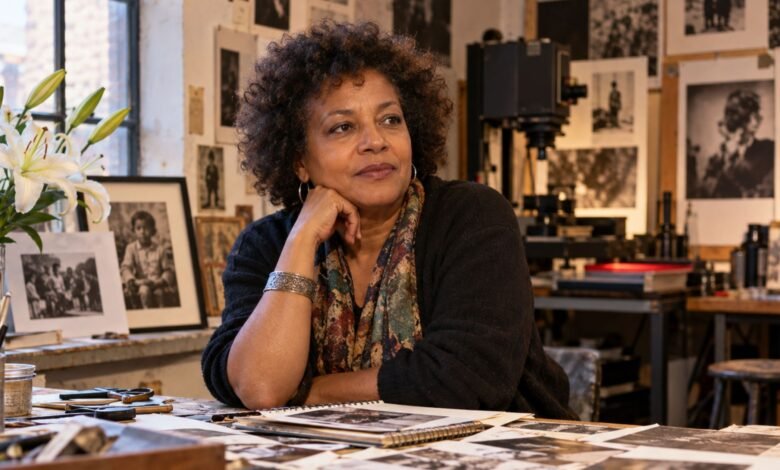
Leah Jaynes Karp occupies an unusual place in public biography: she is the mother of Palantir co-founder and CEO Alex Karp, yet her own documented story belongs primarily to the art world rather than Silicon Valley. Museum records identify her as an American photographer and mixed-media artist born in 1940, while surviving exhibition material places her work in the Chicago photography scene of the 1980s.
Her name has recently attracted renewed interest because readers searching for “Alex Karp’s mother” are discovering that the woman behind that family connection had a substantial creative practice of her own. Leah’s work includes a group of 1982 mixed-media pieces held by Atlanta’s High Museum of Art, among them Mourn Black Murder, Another Black Child’s Name, The Numbers Are Growing, Reward for Information-Victim Eulogized Yesterday and Reflections.
That history adds an important dimension to the biography of Alex Karp. Public accounts of his childhood describe a family shaped by civil-rights activism, Jewish and Black cultural backgrounds, and a strong intellectual interest in social questions. The New York Times reported that Karp’s parents took their children to civil-rights marches and other protests, and described his mother as an artist.
BLUF: Leah Jaynes Karp is an American photographer and mixed-media artist, born in 1940, and the mother of Palantir CEO Alex Karp. Her surviving works include a 1982 High Museum series responding to the Atlanta Child Murders, while museum and photographic records document exhibitions and a career centred on family, identity, memory and social experience.
Leah Jaynes Karp at a Glance
- Full name: Leah Jaynes Karp
- Born: 1940
- Nationality: American
- Profession: Photographer and mixed-media artist
- Spouse: Robert Joseph Karp
- Known publicly as: Alex Karp’s mother
- Documented artistic period: Especially active from the 1970s through the 1990s, according to Getty’s associated artist records.
- Museum collection: High Museum of Art, Atlanta
- Notable work: Mourn Black Murder (1982)
- Chicago exhibition: Museum of Contemporary Photography, September 8–October 11, 1986.
- Family connection: Mother of Alex Karp and his brother Ben, according to biographical reporting and later art-historical discussion.
The Artist the Search Results Nearly Turned Into a Footnote
The easiest way to describe Leah Jaynes Karp is also the least complete: Alex Karp’s mother.
That phrase explains why people encounter her name, but not why institutions have catalogued her work. Getty Research’s Union List of Artist Names classifies her as an American photographer and mixed-media artist, while the High Museum independently identifies her as the artist behind multiple works from 1982.
There is an important distinction here. Leah Karp is not simply a relative of a prominent technology executive whose name appears in an archive because of family genealogy. She has her own institutional footprint.
The High Museum’s collection contains a group of her works, each formally attributed to her. The Museum of Contemporary Photography at Columbia College Chicago also has an exhibition record for a Leah Jaynes Karp exhibition running from September 8 to October 11, 1986.
Her surviving record is therefore strongest when viewed through art institutions rather than celebrity biography websites.
Illinois, Family and an Artistic Career That Came Later
Detailed information about Leah Jaynes Karp’s early life is comparatively scarce. Getty identifies her as American and born in 1940, while later art commentary places her in Illinois and discusses her development as an artist after raising her two sons.
A 2022 essay by artist Simon Denny, published by Texte zur Kunst, revisited Karp’s work and referenced a 1986 Chicago Tribune review of her exhibition. Denny wrote that Karp’s career developed in earnest after she had raised her children and returned to school for art education. The essay also described photographs and family materials as recurring elements in her practice.
That timing matters.
Leah Karp’s artistic identity did not emerge in the same way as that of an artist whose career began immediately after university. The surviving record instead points toward an older, family-centred practice in which ordinary life, memory and cultural inheritance could become raw material.
Her work was therefore not detached from family experience. In some cases, family itself became the subject.
Denny’s discussion of Karp’s photography, drawing on the 1986 Chicago Tribune review, describes imagery linked to one of her sons and to childhood experiences. The review apparently regarded her mixed-media work as sitting near the boundary of folk art, while emphasising the combination of domestic objects, photographs and personal memorabilia.
Also Read About Ralph Pittman: Drew Sidora’s Ex-Husband
The 1986 Chicago Exhibition That Reintroduced Her Work
One of the clearest markers in Leah Jaynes Karp’s public artistic record is her exhibition at the Museum of Contemporary Photography in Chicago in 1986.
The institution’s archive records an exhibition under her name from September 8 through October 11, 1986.
The Chicago context is significant because Karp’s practice occupied an area between documentary photography, personal archive and constructed mixed media. Contemporary discussion of the exhibition focused on photographs, family objects and visual layering rather than on conventional portraiture alone.
A later essay by Simon Denny, which cites the 1986 Chicago Tribune review by Abigail Foerstner, describes one Karp cyanotype as initially resembling something cosmic or biological before revealing a more intimate subject: a child’s hand holding worms during a summer fishing experience. Denny notes that the original review attributed the hand to one of Karp’s sons, although it did not establish which son.
That detail is valuable because it shows how Karp’s art could transform a simple family memory into something visually ambiguous.
The image was not simply a family photograph.
It became an investigation into scale, memory, childhood and the way apparently ordinary fragments acquire meaning when removed from their original context.
“Mourn Black Murder” and the Atlanta Child Murders Series
The most extensively documented portion of Leah Jaynes Karp’s work is the 1982 series connected with the Atlanta Child Murders.
The High Museum identifies Mourn Black Murder as a 1982 dye coupler print on paper with ink. The institution says Karp created the mixed-media series in response to the Atlanta Child Murders, the killings and disappearances of Black children, teenagers and young adults in Atlanta between 1979 and 1981.
The Museum’s record lists the work as part of the Bunnen Collection, with the accession number 1983.62.2.
The work is especially revealing because Karp did not simply reproduce newspaper photography.
Instead, she appropriated words and phrases from the news coverage and combined them with imagery associated with childhood and mourning. The High Museum describes cutout photographs of lilies layered with text taken from news reports.
The result was a visual collision between childhood innocence and the language of violent crime.
The companion works deepen that pattern. The High Museum lists Another Black Child’s Name, The Numbers Are Growing, Another Name Gentle Asphyxiation, Classmates Carry His Coffin. the Mother Mourns M, Reward for Information-Victim Eulogized Yesterday, Chattahoochee River and Reflections among Karp’s works in its collection.
This is not a single isolated artwork. It is a body of work.
How Karp Used Childhood Symbols to Address Adult Violence
The significance of the Atlanta series becomes clearer through Karp’s own explanation of her visual choices.
The High Museum’s Underexposed archive preserves her comments about the construction of Mourn Black Murder. She explained that alphabet and number strips referred to primary experiences shared by children, while the flowers represented childhood and children. She also said that the words came from news broadcasts she listened to while working in her studio.
Karp’s use of notebook-like materials is particularly striking.
Alphabet exercises, handwriting practice, rulers and similar elements are normally associated with elementary education. In her hands, those objects became a frame for newspaper language describing death and disappearance.
The effect was deliberately disorienting.
A child’s visual vocabulary became the surface on which adult tragedy was recorded.
The flowers had their own symbolic role. Karp identified lilies and magnolias as part of the series and connected the life cycle of flowers with childhood and children.
The High Museum’s account therefore establishes something that many short biographies omit: Karp’s best-known work was not merely abstract mixed media. It had a documented subject, a specific historical trigger and an articulated visual method.
The Titles Tell Their Own Story
Karp’s titles are unusually direct.
Another Black Child’s Name.
The Numbers Are Growing.
Classmates Carry His Coffin. the Mother Mourns M.
Reward for Information-Victim Eulogized Yesterday.
These titles retain the vocabulary of news headlines, public grief and statistical counting. The emotional force comes partly from the friction between ordinary words and extraordinary violence.
The High Museum records several of these pieces individually, establishing that the titles were not later inventions by curators but part of the artist’s catalogued body of work.
Her The Numbers Are Growing, for example, is formally catalogued as a 1982 dye coupler print with ink.
The phrase itself carries an unsettling double meaning.
Numbers are useful for measuring events.
But numbers can also conceal the people being counted.
That tension became a defining element of how later writers interpreted Karp’s work.
The Mother of Alex Karp Had Her Own Relationship With “Data”
This is where Leah Jaynes Karp’s story intersects unexpectedly with that of her son.
Alex Karp became famous for building Palantir Technologies, a company whose software is designed around the integration and analysis of large volumes of information. The connection between mother and son has been noticed by contemporary artists and writers precisely because Karp’s visual practice was already concerned with information, classification, family records and the preservation of memory.
That does not establish that Leah Jaynes Karp directly taught Alex Karp how to build software, nor does it prove that her art caused Palantir’s business model.
The evidence supports a more restrained observation.
Both mother and son have documented bodies of work concerned with making meaning from fragments.
For Leah, those fragments included photographs, headlines, flowers, handwriting, family memorabilia and other physical objects.
For Alex, the professional domain became software, databases and organisational systems.
The parallel is compelling because it emerges from documented work rather than family mythology.
Alex Karp’s Childhood Was Shaped by His Parents’ Activism
The family connection itself is well documented.
The New York Times reported that Alex Karp was born in New York and raised near Philadelphia in a family with a Jewish father who was a paediatrician and a Black mother who was an artist. The newspaper also reported that his parents were social activists who took their children to civil-rights marches and other protests.
This helps place Leah within the environment in which Alex Karp grew up.
She was not simply the private parent of a future billionaire.
She was part of a household where race, identity, justice and social participation were visible parts of family life.
Karp later described a strong identification with fighting discrimination and acknowledged the influence of his maternal family background in his public discussions of identity. Those statements are about Alex Karp’s later self-understanding, not evidence of Leah’s private beliefs beyond the public record.
That distinction matters because biographies can easily move from documented family history into assumptions about private motives.
Two Sons, a Jewish Family and the Personal Archive
Later art criticism adds further context to Leah Jaynes Karp’s family life.
Simon Denny’s essay, drawing on the 1986 Chicago Tribune review, describes Karp as a Black woman who was the daughter of a Baptist minister, married into a Jewish family and had two sons.
The same discussion emphasises the role of personal objects in Karp’s work, including snapshots and family memorabilia.
These details make her use of the family archive more understandable.
A photograph was not merely evidence of an event.
It could carry lineage.
A childhood object could become a historical marker.
A family image could become a statement about culture.
The result is a form of autobiography without the conventional structure of a written memoir.
What Museum Records Can Actually Establish
The surviving evidence gives a surprisingly clear answer to some questions and a very cautious answer to others.
| Question | What the public record establishes |
|---|---|
| Who is Leah Jaynes Karp? | An American photographer and mixed-media artist |
| When was she born? | 1940 |
| Where is she from? | Later art commentary identifies Illinois; Getty confirms her American identity but does not provide a detailed early-life biography |
| Was she an artist before Alex Karp became famous? | Yes; museum records document her work decades before Palantir’s prominence |
| What medium did she use? | Photography and mixed media, including dye coupler prints |
| What is her best-documented series? | The 1982 works responding to the Atlanta Child Murders |
| Where is her work held? | The High Museum of Art is a documented institutional collection |
| Did she exhibit in Chicago? | Yes; the Museum of Contemporary Photography records a 1986 exhibition |
| Did she raise children? | Later art-historical commentary states that she raised two sons |
| Is she Alex Karp’s mother? | Yes; multiple biographical accounts identify her as his mother |
| Is her current residence publicly established? | Not reliably established by the sources reviewed |
| Is her current professional activity publicly established? | Not reliably established by authoritative recent records reviewed |
The pattern is clear: the strongest evidence concerns her art, while her later private life is far less visible.
Leah Jaynes Karp’s Financial Record Is Not Publicly Established
For a biography, financial questions are often among the most searched.
In Leah Jaynes Karp’s case, however, precision would be misleading.
There is no authoritative public figure establishing Leah Jaynes Karp’s personal net worth, annual income, salary or total asset value in the sources reviewed for this profile.
The fact that her work appears in a major museum collection does not by itself establish what any individual piece is worth in the private market. Museum collection status is not the same thing as a documented auction valuation or personal fortune.
Likewise, being the mother of a highly successful technology executive does not establish inheritance, shared assets or personal wealth.
Any websites publishing a specific net-worth figure for Leah Jaynes Karp without accompanying audited accounts, estate documents, tax records, sale records or another authoritative financial source should therefore be treated cautiously.
The responsible answer is simple: her individual wealth is currently unverified in authoritative public sources.
A Timeline of the Publicly Documented Record
- 1940: Leah Jaynes Karp is recorded by Getty as born in the United States.
- 1970s–1990s: Getty’s associated artist record identifies a photographic practice flourishing across this broader period.
- 1982: Karp creates a series of mixed-media works responding to the Atlanta Child Murders.
- 1982: High Museum records include Mourn Black Murder, The Numbers Are Growing, Another Black Child’s Name, Reflections and related works.
- 1983: The High Museum accession records place works from the series into the museum collection under the Bunnen Collection.
- 1986: The Museum of Contemporary Photography records a Leah Jaynes Karp exhibition in Chicago from September 8 to October 11.
- 2022: Artist Simon Denny revisits Karp’s work in Texte zur Kunst, connecting her family archive and visual language with later discussions surrounding Palantir and Alex Karp.
- 2024: The New York Times again discusses Alex Karp’s family background, identifying his mother as a Black artist and describing the parents’ involvement in civil-rights activism.
What Is Verified, and What Should Stay Out of a Biography
Strongly supported
The following statements are supported by institutional or high-quality documentary evidence:
- Leah Jaynes Karp is an American artist born in 1940.
- Getty classifies her as a photographer and mixed-media artist.
- She produced a substantial body of work during the late twentieth century.
- The High Museum of Art holds multiple works by her.
- Her 1982 series addressed the Atlanta Child Murders.
- The Museum of Contemporary Photography records a 1986 exhibition under her name.
- Alex Karp is her son.
- She and Alex Karp’s father were described in the New York Times as social activists who exposed their children to civil-rights marches and protests.
Not firmly established by the reviewed sources
A responsible profile should avoid presenting the following as settled facts without stronger documentation:
- An exact birth date
- A precise current age based on an assumed birthday
- A current home address or residence
- A current income figure
- A precise personal net worth
- Private property holdings
- Detailed medical or personal information
- Unverified stories about family finances
- Claims that Leah directly influenced the technical creation of Palantir
The distinction between evidence and inference is especially important for a person whose public identity has often been overshadowed by a famous child.
Why Leah Jaynes Karp’s Story Matters Beyond the Family Tree
There is a temptation to treat biographies like family diagrams.
Mother.
Father.
Son.
Company.
But Leah Karp’s record resists that simplicity.
Her work asks questions about what happens when private memory enters public history. She took material associated with childhood, domestic life and personal recollection and placed it against news language documenting violence.
That choice transformed everyday objects into evidence of a particular cultural moment.
It also explains why her work has remained relevant to later writers examining Alex Karp.
Artist Simon Denny explicitly approached Leah’s work through questions of information, family ties and the processing of fragments. His interpretation is his own critical reading, not a claim that mother and son shared an artistic programme.
Still, the underlying documents are striking.
A mother made photographs, collages and personal archives.
Her son later became known for systems built to connect enormous bodies of information.
The resemblance is conceptual rather than causal, and that distinction makes the story more credible, not less.
A Public Record That Ends Where the Private Life Begins
One of the most revealing facts about Leah Jaynes Karp is how little reliable material exists about the later decades of her life compared with the documentation of her art.
That absence should not be mistaken for insignificance.
It is simply the boundary of the public record.
Museums can preserve a photograph.
A gallery can preserve an exhibition date.
An artist archive can preserve a title and medium.
None of those sources automatically reveal how someone spent the next thirty years of private life.
For that reason, the most defensible biography of Leah Jaynes Karp centres on what can actually be demonstrated: her artistic identity, her 1980s exhibition history, her High Museum works, her documented relationship to family imagery and her role in the family history of Alex Karp.
The evidence is strong enough to make her story interesting without inventing the missing chapters.
Frequently Asked Questions About Leah Jaynes Karp
Who is Leah Jaynes Karp?
Leah Jaynes Karp is an American photographer and mixed-media artist born in 1940. She is also the mother of Palantir co-founder and CEO Alex Karp. Her work is represented in the High Museum of Art, where several 1982 mixed-media pieces document her response to the Atlanta Child Murders.
Is Leah Jaynes Karp Alex Karp’s mother?
Yes. Leah Jaynes Karp is Alex Karp’s mother. The New York Times identifies Karp’s mother as a Black artist and describes the activist household in which he was raised near Philadelphia. Later art writing also identifies Leah as the mother of two sons, including Alex.
What did Leah Jaynes Karp do for a living?
Leah Jaynes Karp worked as a photographer and mixed-media artist. Getty’s artist authority record classifies her under both photography and mixed media, while museum records preserve multiple examples of her work. She also had a documented exhibition at Chicago’s Museum of Contemporary Photography in 1986.
What happened to Leah Jaynes Karp’s artwork?
Leah Jaynes Karp’s work entered institutional collections, most clearly at the High Museum of Art in Atlanta. The museum currently catalogues multiple works by her, including Mourn Black Murder, Another Black Child’s Name, The Numbers Are Growing and Reflections. The museum pages reviewed indicate that these individual works are not currently on view.
What is Leah Jaynes Karp’s net worth?
Leah Jaynes Karp’s personal net worth is not verified by authoritative public sources reviewed for this article. Museum ownership of artwork does not establish a personal fortune, and no audited financial statement or reliable public disclosure reviewed here supports a precise figure.
What did Leah Jaynes Karp create in 1982?
In 1982, Leah Jaynes Karp created a series of mixed-media works responding to the Atlanta Child Murders. The High Museum identifies works including Mourn Black Murder, The Numbers Are Growing and Another Black Child’s Name. The series incorporated news language, educational imagery and flowers associated by Karp with childhood.
Where did Leah Jaynes Karp exhibit her art?
One documented exhibition took place at the Museum of Contemporary Photography at Columbia College Chicago from September 8 through October 11, 1986. Her work is also preserved by the High Museum of Art in Atlanta.
The Significance of Leah Jaynes Karp Is in the Record She Left
Leah Jaynes Karp’s story is more interesting than a parenthetical family reference.
She was an artist with a documented institutional history, a photographer whose work engaged with family and memory, and the creator of a 1982 body of work responding directly to one of the most painful episodes in Atlanta’s modern history. Museum records preserve that work independently of her son’s fame.
Her connection to Alex Karp adds another layer, but it should not swallow the first one.
The public record does not establish that Leah designed the worldview behind Palantir, shaped every stage of her son’s career or intended her work to foreshadow modern data technology.
What it establishes is simpler and more compelling.
She created art out of information.
She turned headlines into visual objects.
She used family photographs and childhood symbols to preserve experiences that might otherwise have disappeared into statistics.
And decades later, her son became one of the most recognisable executives in an industry built around finding patterns in enormous amounts of information.
That parallel does not need embellishment.
The artwork is already there.
Sources & Verification
- Getty Research Institute — Union List of Artist Names: Leah Jaynes Karp — artist classification, nationality and birth year.
- High Museum of Art — “Mourn Black Murder” — 1982 artwork, medium, collection record and subject matter.
- High Museum of Art — Underexposed: “Mourn Black Murder” — Karp’s own explanation of her materials and symbolism.
- Museum of Contemporary Photography — Leah Jaynes Karp exhibition record — Chicago exhibition dates in 1986.
- New York Times — Palantir’s Alex Karp Talks About War, AI and America’s Future — family background and Alex Karp’s description of his upbringing.
- Texte zur Kunst — “Quantified Ties” by Simon Denny — later art-historical discussion of Karp’s family imagery, exhibition history and 1982 work.
Editorial Disclaimer
This profile distinguishes documented information from interpretation and unverified online claims. Leah Jaynes Karp’s public record is substantially stronger for her artwork and exhibitions than for her private life. Financial figures, current residence, later-life activities and other personal details have not been presented as fact where authoritative verification was unavailable.



One Comment